Tips for JLPT from the Native Japanese Teacher

Tips to efficiently pass the JLPT - Advice from the native Japanese teacher - 1) Know the structure 2)Time managing 3) Daily training

→ Free Learning Platform ←
JLPT Tips

IPPO, Becoming a Global Standard for the JLPT

The Japanese Language Proficiency Test (JLPT) is widely recognized worldwide as an exam that measures the Japanese language abilities of learners. In recent years, the JLPT has begun to play a role beyond just being an exam. This article will provide a detailed introduction to how the JLPT is being utilized in Japanese universities and companies, and the benefits it offers to learners.
2026.01.29
article-jlpt-grammar

【JLPT N4】Particle と(To): Your Ultimate Guide for the JLPT

と serves as a bridge : Connecting Nouns, Identifying a Partner, Indicating Natural Consequences (Conditionals), and Quoting Thoughts or Speech.
article-jlpt-grammar

【JLPT N4】Nuances of Time with ところだ(Tokoro Da)

ところだ(Tokoro Da) If you have been studying Japanese for a while, you’ve probably reached that frustrating plateau whe...
article-jlpt-grammar

【JLPT N4】Essential Japanese Grammar: How to Use 〜という (to iu)

〜という is used to define, name, or describe something. Think of it as a way to say "called," "named," or "the thing that is..." in English.
article-jlpt-grammar

【JLPT N4】Art of Patience with なかなか〜ない(Nakanaka Nai)

Feeling that something is taking much longer than it should? Then you are already familiar with the spirit of the Japanese grammar point なかなか〜ない (Nakanaka~nai).
article-jlpt-grammar

~なさい (~nasai) When Authority Meets Care in Japanese

~なさい is the imperative form of the honorific verb なさる (nasaru), which is the polite version of する (suru). However, it has evolved into a "soft imperative."
article-jlpt-grammar

【JLPT N4】~にくい(Nikui) How to Express When Things Are Hard to Do

In English, 〜にくい (~nikui) is "hard to do" or "difficult to handle." In Japanese, however, there is a very specific point for these exact situations.
article-jlpt-grammar

【JLPT N4】Mastering Conditionals: How to Use Nara Correctly

Unlike other conditionals, ~nara is used when you are picking up on a topic that someone else mentioned, or a situation that has just become apparent.
article-jlpt-grammar

【JLPT N4】How to Use にする(Ni Suru) to Express Your Choices

〜にする (ni suru) translates most to "to decide on" or "to make it [something]." It’s the grammar used when we have options in front of us and we are picking one.
article-jlpt-grammar

【JLPT N4】 “Node” to Explain Reasons with Politeness

"node" (ので) is used to connect a reason to a result. It is "because", however, unlike its cousin から, ので places the emphasis on the objective circumstances.
article-jlpt-grammar

【JLPT N4】のに(Noni) to Express Disappointment & Unexpected
Outcomes

In English, "even though," "despite" or "although." But in Japanese, there is a specific grammar point that carries a much heavier emotional weight: 〜のに (noni).
article-jlpt-grammar

【JLPT N4】Particle と(To): Your Ultimate Guide for the JLPT

と serves as a bridge : Connecting Nouns, Identifying a Partner, Indicating Natural Consequences (Conditionals), and Quoting Thoughts or Speech.
article-jlpt-grammar

【JLPT N4】Nuances of Time with ところだ(Tokoro Da)

ところだ(Tokoro Da) If you have been studying Japanese for a while, you’ve probably reached that frustrating plateau whe...
article-jlpt-grammar

【JLPT N4】Essential Japanese Grammar: How to Use 〜という (to iu)

〜という is used to define, name, or describe something. Think of it as a way to say "called," "named," or "the thing that is..." in English.
article-jlpt-grammar

【JLPT N4】Art of Patience with なかなか〜ない(Nakanaka Nai)

Feeling that something is taking much longer than it should? Then you are already familiar with the spirit of the Japanese grammar point なかなか〜ない (Nakanaka~nai).
article-jlpt-grammar

~なさい (~nasai) When Authority Meets Care in Japanese

~なさい is the imperative form of the honorific verb なさる (nasaru), which is the polite version of する (suru). However, it has evolved into a "soft imperative."
article-jlpt-grammar

【JLPT N4】~にくい(Nikui) How to Express When Things Are Hard to Do

In English, 〜にくい (~nikui) is "hard to do" or "difficult to handle." In Japanese, however, there is a very specific point for these exact situations.
article-jlpt-grammar

【JLPT N4】Mastering Conditionals: How to Use Nara Correctly

Unlike other conditionals, ~nara is used when you are picking up on a topic that someone else mentioned, or a situation that has just become apparent.
article-jlpt-grammar

【JLPT N4】How to Use にする(Ni Suru) to Express Your Choices

〜にする (ni suru) translates most to "to decide on" or "to make it [something]." It’s the grammar used when we have options in front of us and we are picking one.
article-jlpt-grammar

【JLPT N4】 “Node” to Explain Reasons with Politeness

"node" (ので) is used to connect a reason to a result. It is "because", however, unlike its cousin から, ので places the emphasis on the objective circumstances.
article-jlpt-grammar

【JLPT N4】のに(Noni) to Express Disappointment & Unexpected
Outcomes

In English, "even though," "despite" or "although." But in Japanese, there is a specific grammar point that carries a much heavier emotional weight: 〜のに (noni).
JLPT Tips

Japan’s Dwindling Population: A Looming Crisis and the Rise of Japanese Language Learning

In the face of a shrinking population and an increasingly diverse workforce, Japanese language learning has become more important than ever. Proficiency in Japanese is essential for foreign workers to fully integrate into Japanese society and contribute effectively to the economy.
2026.01.23
JLPT Tips

IPPO, Becoming a Global Standard for the JLPT

The Japanese Language Proficiency Test (JLPT) is widely recognized worldwide as an exam that measures the Japanese language abilities of learners. In recent years, the JLPT has begun to play a role beyond just being an exam. This article will provide a detailed introduction to how the JLPT is being utilized in Japanese universities and companies, and the benefits it offers to learners.
2026.01.29
JLPT Tips

IPPO: Revolutionizing Japanese Language Learning in University Collaborations

Explore the groundbreaking impact of IPPO in revolutionizing Japanese language learning through innovative university collaborations, offering a transformative approach to language education.
2026.01.29
JLPT Tips

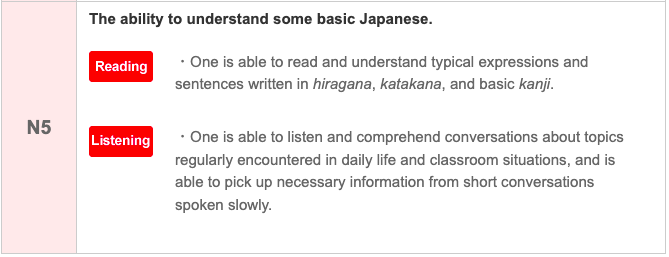
How to Pass JLPT N5: Complete Study Guide, Passing Score & Beginner Tips

The Japanese Language Proficiency Test (JLPT) N5 is the first step in your journey toward Japanese language mastery. As the easiest of the five JLPT levels, N5 is an excellent starting point for beginners.
2026.03.13
JLPT Tips

JLPT N1 Tips: Achieving the Pinnacle of Japanese Language Proficiency

The Japanese Language Proficiency Test (JLPT) N1 is the highest level of the JLPT, representing the pinnacle of Japanese language proficiency. Reach this level and you are a hero!
JLPT Tips

Mastering the JLPT: Top Study Materials and Tips for Each Level

The Japanese Language Proficiency Test (JLPT) is a highly-regarded examination that measures your ability to understand and use the Japanese language. Passing the JLPT can open doors to educational and professional opportunities in Japan and beyond. In this blog post, we will discuss essential study materials, tips for each level, and strategies for mastering the JLPT.
JLPT Tips

Ace the JLPT: Comprehensive Preparation for All Levels

In this blog post, we will provide an all-encompassing guide to help you excel in your JLPT journey, covering the test format, study resources for each level, techniques for mastering grammar, vocabulary, kanji, listening, and reading comprehension, as well as effective test preparation tips.
2026.01.29
JLPT Tips

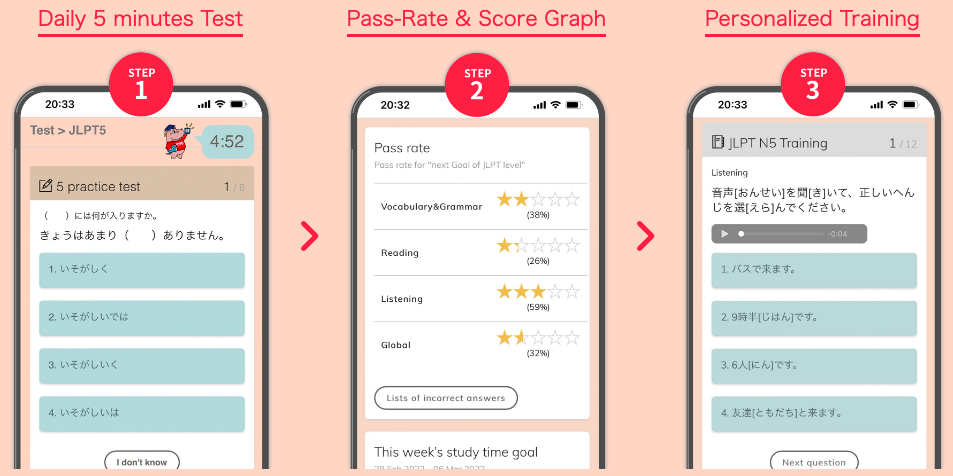
IPPO, Digitalized Textbook for JLPT Training!

IPPO is an App that helps Japanese Learners to pass JLPT. If you can be a loyal user of IPPO, you will see a drastic difference.
2026.01.29
\Share IPPO with friends/
Back to top
Copied title and URL